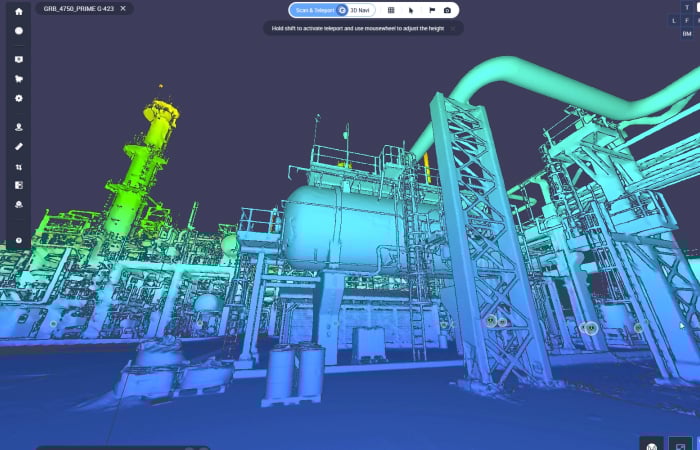
An asset integrity digital twin gives industrial teams a continuously accurate, 3D picture of their facility so that conditions, change and risk are all visible and incidents can be avoided.
What is an Asset Integrity Digital Twin
An asset integrity digital twin is a precise, up-to-date virtual replica of a facility, built from reality capture data and enriched with the information teams need to maintain safe and reliable assets.
It extends beyond a static 3D model or folder of laser scans. The twin ties as-built geometry to asset records, metadata, inspection history and live operational data, creating a single environment where engineers, operators and asset managers can see exactly what exists on site and understand its condition.
Asset integrity management ensures equipment operates safely and performs as intended throughout its entire lifecycle. For this discipline to work, teams need trustworthy, current information about the physical plant as opposed to trying to work from drawings that are a decade old and no longer match reality.
A reality-based digital twin closes this gap by grounding every decision in the actual state of the facility, captured to millimeter accuracy and accessible to everyone who needs it.
Why Aging Facilities Put Asset Integrity at Risk
Most industrial facilities in operation today are brownfield sites. They’ve been extended, retrofitted and re-piped multiple times and the documentation rarely keeps pace with the changes being made in the field. The result is a persistent gap between the plant as-designed and the plant as it actually stands.
That gap is where asset integrity risk lives. Engineers plan modifications against outdated P&IDs; maintenance crews arrive on site to find the layout differs from the records. Clashes go undetected until fabrication, driving rework and schedule delays.
As facilities age and workforces change, the institutional knowledge that once filled those gaps disappears too. An asset integrity digital twin captures the current reality of the site and keeps it current, so aging infrastructure doesn’t translate into growing uncertainty.
%20Companies..webp?width=1200&height=675&name=5%20Reasons%20Digital%20Twins%20Are%20Essential%20for%20Energy%20(Oil%20%26%20Gas)%20Companies..webp) From Static Point Clouds to a Living Digital Twin
From Static Point Clouds to a Living Digital Twin
Reality capture usually begins with 3D laser scanning, which produces dense point clouds of a facility. These point clouds are accurate but heavy, often multiple gigabytes, making them difficult to share, navigate or connect to other systems. Left in their raw form, valuable data ends up siloed on local workstations, viewed by a handful of specialists and rarely used again.
Cintoo puts an end to this by converting point clouds into lightweight, high-resolution meshes hosted in the cloud. Instead of wrestling with massive raw data files, teams navigate a fast, browser-based 3D environment that preserves the accuracy of the original scan. This is the foundation of a living digital twin – reality capture data that anyone on the project can open, measure and collaborate on, from any location, without needing specialized hardware. The scan goes from being a one-time deliverable to an operational asset the whole organization can use.
Turning Reality Capture Into a Single Source of Truth
Fragmented data is one of the biggest obstacles to asset integrity. Scans live in one place, asset registers in another, inspection reports another still and drawings somewhere else entirely. When information is scattered, teams can’t trust any single version of it.
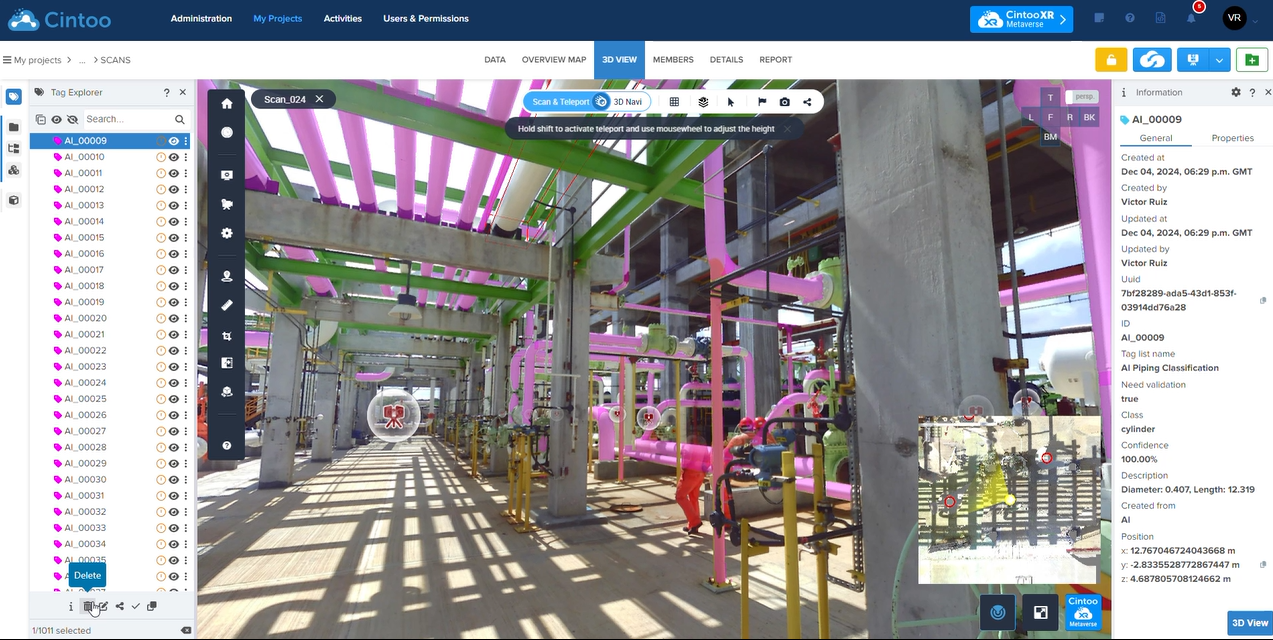
An asset integrity digital twin consolidates this information into a single source of visual truth. Cintoo’s Twin Edition lets teams unify 3D scan data and contextualize as-built conditions, so equipment, layout and site conditions can be verified from one shared environment. AI-driven object classification and custom asset tagging make it possible to organize components spatially and semantically, so assets can be easily searched, grouped and maintained rather than hours spent trying to locate them.
Metadata enrichment attaches notes, specifications and status directly to equipment inside the 3D environment. Everyone from asset managers to CAD designers works from the same accurate, current picture, removing ambiguity and reducing costly errors that come from acting on the wrong information.
 Enabling Remote Inspections and Reducing Site Visits
Sending people onto an operating industrial site carries both cost and risk. Access can depend on permits, shutdowns, confined-space entry or travel to remote locations. Every avoidable trip adds expense and unnecessary exposure.
A cloud-based digital twin lets teams inspect assets remotely, in accurate 3D, without leaving the office. Operators and planners can perform virtual walkthroughs, measure clearances, verify equipment and plan maintenance from the twin, reserving physical visits for the work that genuinely requires boots on the ground.
Extropic Energy, for example, used Cintoo to reduce site visits by up to 50% and cut unplanned downtime by 10-15%, while improved design coordination and clash detection lowered rework and schedule delays by 20-30%.
For asset integrity teams, fewer site visits mean faster inspection cycles, safer operations and more time spent on decision-making rather than logistical planning.
Connecting Asset Data Across Enterprise Systems
An asset integrity digital twin becomes far more powerful when it’s connected to the systems that already run the facility. On its own, a 3D model tells you what an asset looks like; connected to operational data, it tells you how that asset is performing and what it needs.
Cintoo Twin Edition links the interactive 3D environment with key enterprise systems – ERP, MES, CMMS and IoT sensors – so asset data is enriched with live, contextual insight. Maintenance records, work orders and sensor readings can be tied directly to the physical assets and facility areas they describe. Teams can also bring existing documentation into the twin through connected P&IDs, importing PDF or TIFF drawings into a viewer alongside the 3D scan data to locate instrumentation, trace piping and align drawings with reality. The twin becomes a unified view of operations, maintenance and performance – exactly the kind of joined-up information asset integrity depends on.
Tracking Change and Deterioration Over Time
Asset integrity is an ongoing assessment of how conditions evolve. Catching continuous changes, like corrosion and modifications, early is the difference between planned maintenance and emergency response.
Because the twin is built from repeatable reality capture, teams can compare scans taken at different dates to see exactly what has changed. That makes it possible to detect asset deterioration, confirm that repairs and modifications were completed correctly and document the facility’s condition over its lifecycle. Instead of relying on memory or sporadic manual checks, teams get an objective, time-stamped record of the physical plant. This supports a more predictive approach to maintenance, monitoring how assets change and intervening before small issues become failures, rather than reacting after equipment is already down.
Supporting Safety, Compliance and Audit Readiness
For process industries, compliance and asset management are inseparable from safety. Regulators and internal standards demand evidence that equipment is inspected, maintained and operating within limits and this evidence needs to be current and defensible.
An asset integrity digital twin makes that evidence easy to produce. Inspection history, asset metadata and condition records live alongside the accurate 3D geometry they relate to so teams can demonstrate the state of the facility at any point in time. Remote access to a verified single source of truth means audits and reviews can happen without mobilizing crews for every check. Enterprise-grade security underpins this – Cintoo is ISO 27001 and SOC2 compliant so sensitive facility data is protected to the standards industrial operators require. The twin turns compliance from a periodic scramble into a continuous, well-documented capability.
How Industrial Teams Get Started With an Asset Integrity Digital Twin
Building an asset integrity digital twin doesn’t require replacing your existing workflows, it requires giving them a reliable, shared foundation of reality. The path typically starts with the scan data many facilities already have – convert those points clouds into a cloud-based, navigable twin, classify and tag thee assets that matter most, then connect the twin to the maintenance and operations systems your teams use every day.
From there, the value compounds. Each new scan keeps the twin current and adds another point of comparison while each connected system adds context and remote inspection saves a trip. For industrial facilities facing aging infrastructure, tightening regulations and pressure to reduce downtime, an asset integrity digital twin isn’t a nice-to-have visualization but the operational backbone that keeps assets safe, reliable and understood throughout their lifecycle.
To see how Cintoo supports asset visualization and integrity for industrial facilities, request a demo and explore what a reality-based digital twin can do for your operations.



.png?width=48&height=48&name=sensors%20(1).png)
.png?width=65&height=50&name=sensors%20(2).png)


.png?width=69&height=50&name=cloud_done%20(1).png)


.png?width=42&height=49&name=Group%2015496%20(2).png)


.png?width=60&height=60&name=calendar%20(1).png)


.png?width=48&height=45&name=image%20175%20(1).png)