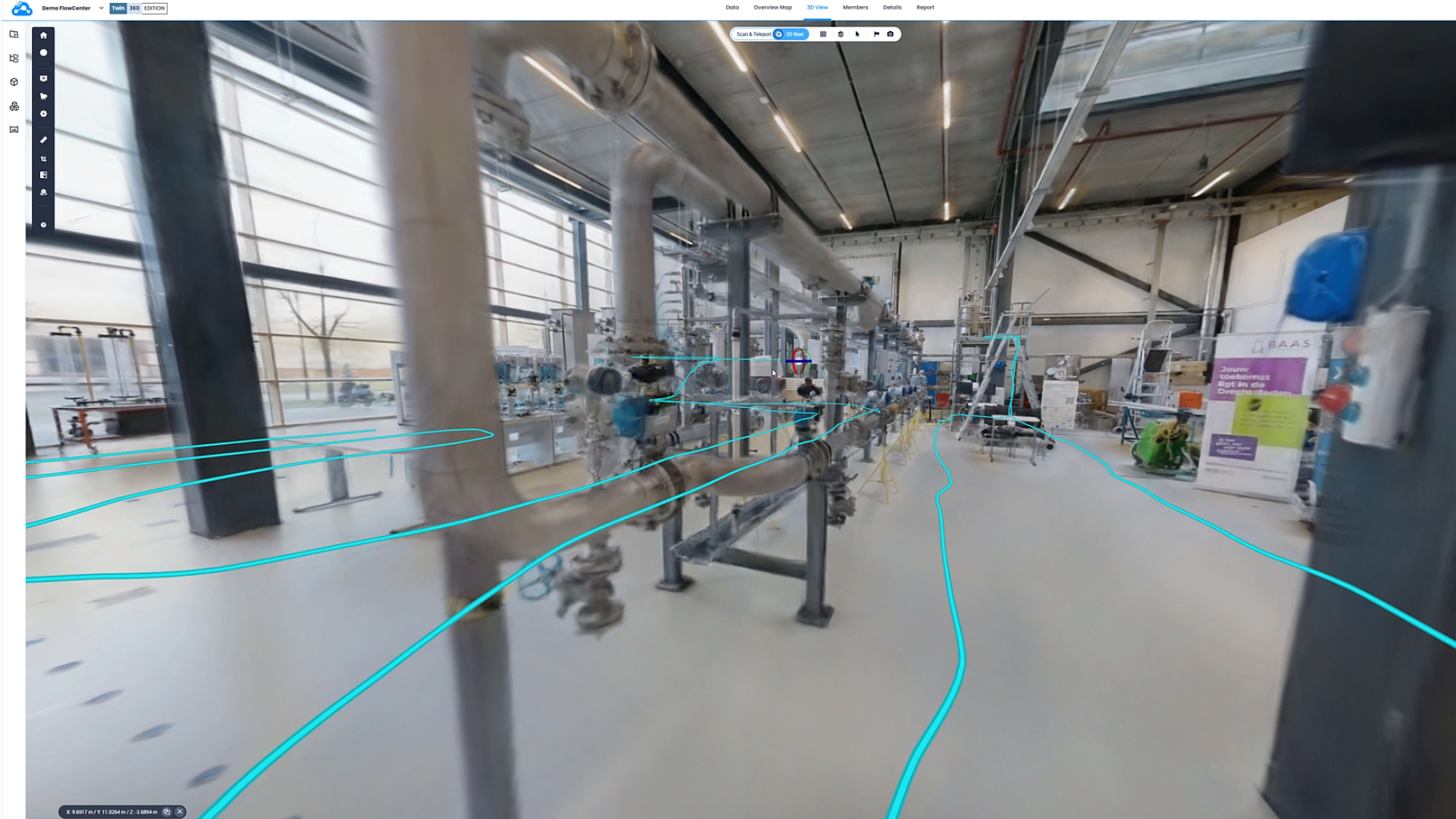
Traditional reality capture workflows have long been constrained by fixed schedules, high costs, and limited flexibility. In our recent webinar, Cintoo, in partnership with Ricoh, unveiled how Cintoo’s 360 Edition is designed to bridge the gap between high‑precision laser scanning and the need for more frequent, lightweight site visibility.
Led by Dominique Pouliquen (CEO, Cintoo), Thomas Servan (Ricoh), and Derek Lawrence (Reality Capture Expert), the session explored how 360 imagery and Gaussian splatting can extend reality capture into a more continuous, cost‑effective resource, without replacing survey‑grade scanning.
Why 360 Edition Was Built
Cintoo has always positioned itself as a hardware‑agnostic, multi‑modal SaaS platform capable of transforming point clouds into high‑resolution 3D meshes streamed directly in a web browser. During the webinar, Dominique explained that the addition of 360 imagery was driven by real customer demand for faster inspection and update workflows.
By supporting 360 video capture alongside laser scans, BIM, CAD, and GIS data, Cintoo extends its role as a single source of truth for digital twin workflows. As Dominique noted, the goal is not “either laser scanning or 360 imagery,” but a complementary approach where each technology is used where it delivers the most value.
How It Works: From Field to Cloud
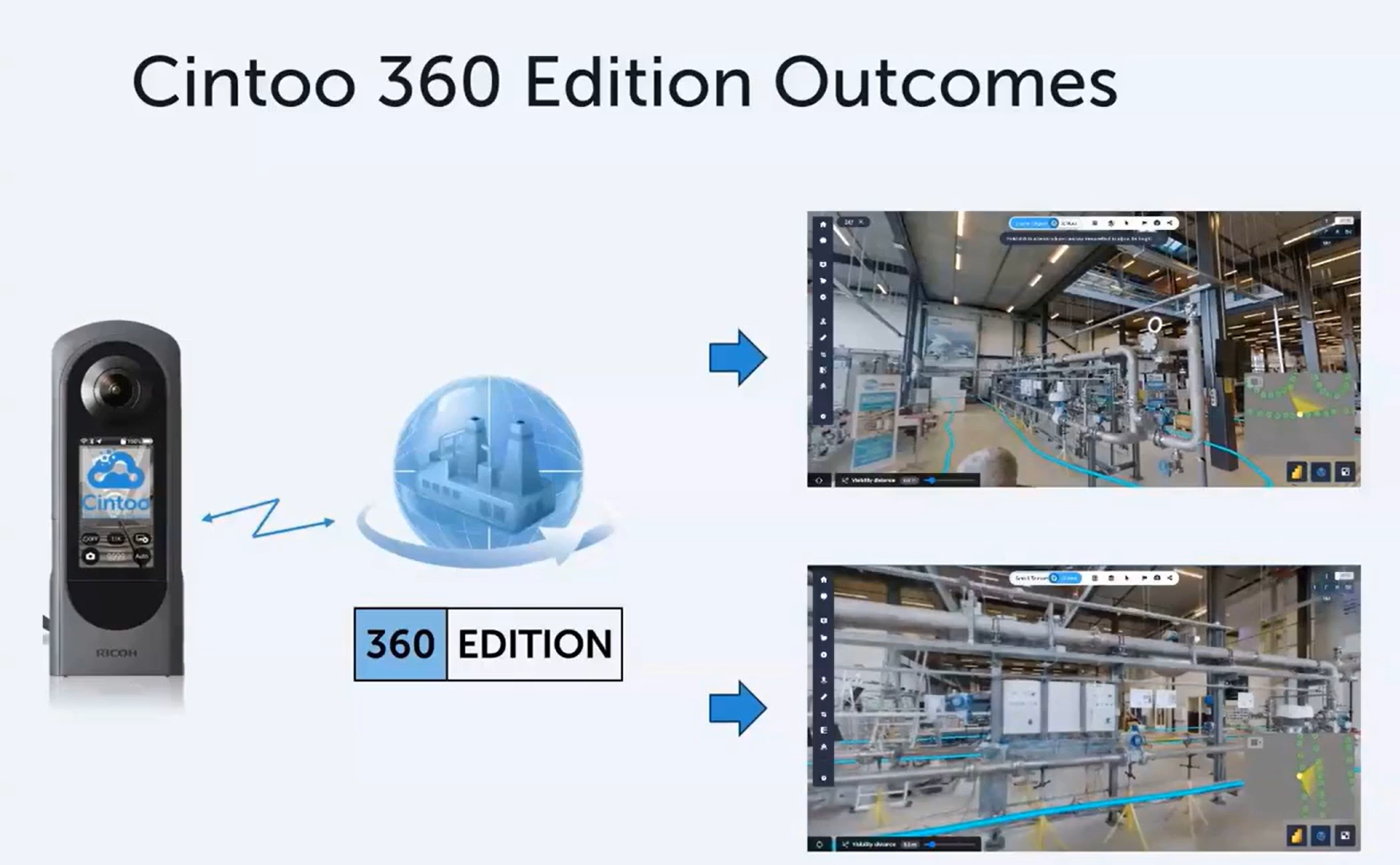
Using the Ricoh THETA X, teams can walk through a facility with a helmet‑mounted camera or handheld stick, capturing 360 video at a slow, controlled pace. That footage is automatically uploaded to Ricoh’s cloud and then securely fetched into Cintoo—no manual file transfers required.
Once processed, users gain two key outputs:
-
Navigable 360 images along a camera path
-
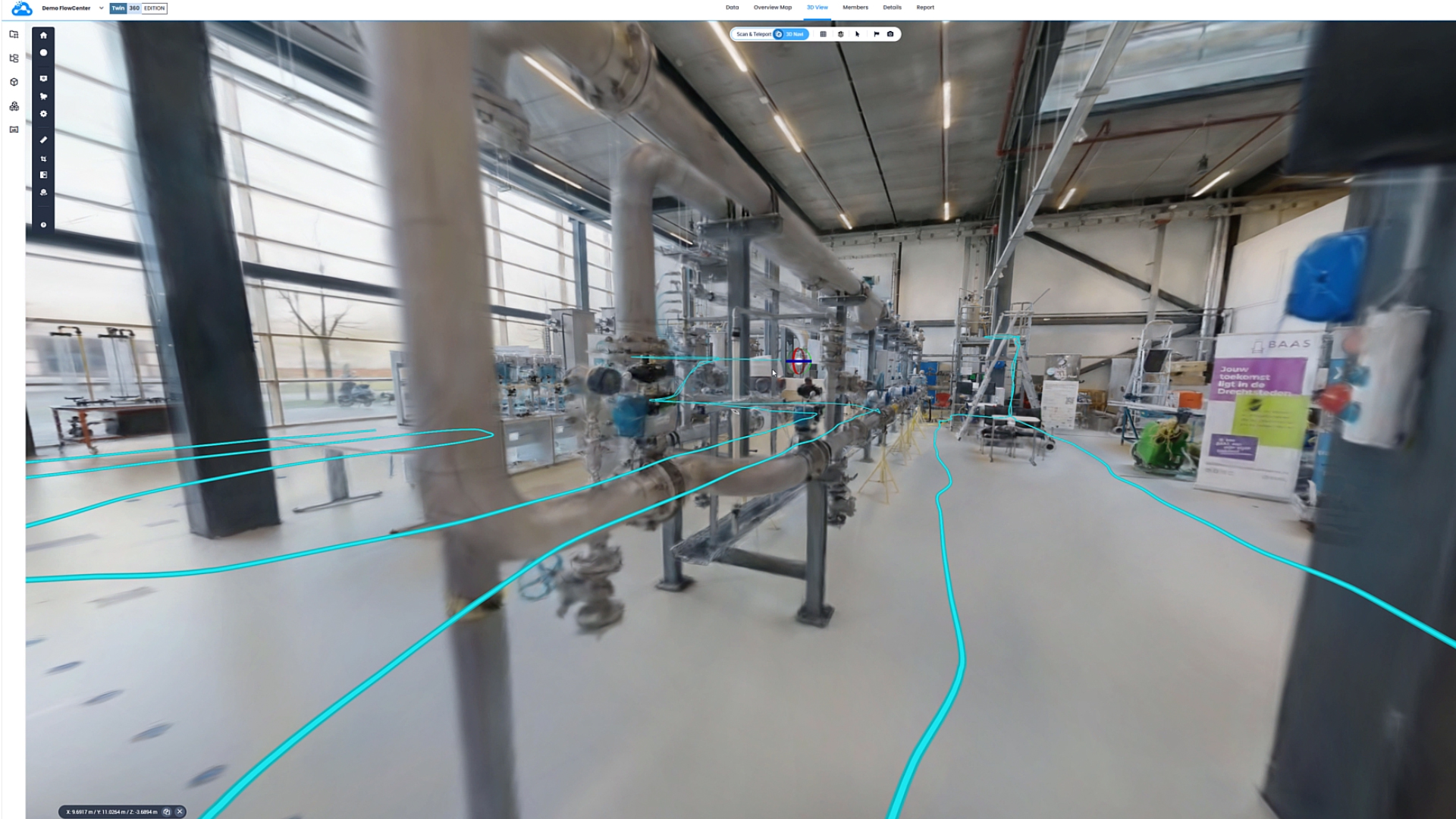
3D Gaussian splats, which provide photorealistic, spatially accurate visualization suitable for navigation, measurements, annotations, and asset tagging
Unlike traditional split‑screen approaches, Cintoo integrates all modalities—360 imagery, Gaussian splats, laser scan meshes, and BIM models—into a single unified 3D environment, a major differentiator highlighted throughout the session.
Gaussian Splats vs. Laser Scans: Knowing When to Use Each
A key takeaway from the webinar was transparency around accuracy. Gaussian splats provide what Dominique described as “visual‑grade accuracy,” typically within plus or minus one inch, making them ideal for navigation, inspections, and contextual understanding. Laser scans, on the other hand, remain essential for survey‑grade engineering work where millimeter‑level precision is required.
This distinction enables teams to optimize laser scanning, using it only where necessary and relying on 360 capture to maintain day‑to‑day visibility.
Practical Use Cases in the Field
Reality capture expert Derek Lawrence, who is actively testing the product, shared how the solution helps teams update environments that were previously scanned without color or are no longer current. By layering 360 imagery and Gaussian splats over existing data, teams can quickly regain context without commissioning new scans.
Another powerful use case discussed was bridging the gap between scans. Instead of re‑scanning entire facilities “just in case,” teams can identify exactly where survey‑grade data is missing and target those areas. As General Motors, an early adopter, summarized, this approach makes “laser scanning become surgical", meaning you scan only where you truly need survey‑grade accuracy.
ROI: Where the Value Adds Up
The webinar also walked through expected return on investment scenarios, including:
-
Reducing unscheduled or repeat laser scans
-
Minimizing site visits by enabling remote re‑access to current conditions
-
Saving time across engineering, operations, and maintenance teams
-
Scaling reality capture efficiently across multiple sites with standardized 360 workflows
Even saving one or two days of external scanning work can justify the investment, while faster onboarding and same‑day results accelerate time to value.
Key Takeaways
By combining lightweight 360 capture with high‑fidelity 3D visualization, Cintoo’s 360 Edition turns reality capture into a continuous, on‑demand resource. Teams gain faster insight, better collaboration, and more confident decision‑making without sacrificing accuracy where it matters most.
Watch the full webinar recording here:



.png?width=48&height=48&name=sensors%20(1).png)
.png?width=65&height=50&name=sensors%20(2).png)


.png?width=69&height=50&name=cloud_done%20(1).png)


.png?width=42&height=49&name=Group%2015496%20(2).png)


.png?width=60&height=60&name=calendar%20(1).png)


.png?width=48&height=45&name=image%20175%20(1).png)