Unplanned downtime is still the most expensive problem on many industrial sites. A single unexpected failure on a critical asset can cost more in a few hours than an entire year of planned maintenance. That's why reliability teams have spent the last decade moving from reactive and calendar-based maintenance toward predictive strategies built on real condition data.
But there's a gap that quietly undermines a lot of predictive maintenance programs. The data, describing what the plant actually looks like today, is often missing, outdated or trapped in files nobody can open. Engineering drawings drift from reality, equipment gets modified in the field and never redlined, and laser scans, that could close the gap, sit on a server as terabyte-scale point clouds that no one outside the survey team can realistically use.
This is where usable reality capture data comes in, with a crucial role to play in predictive maintenance. Here's how it fits into an industrial digital twin and what it takes to turn massive scan datasets into something your reliability and operations teams can act on.
Why most digital twins fall short on predictive maintenance
A digital twin is only as good as the reality it reflects. Many industrial twins use a 3D model that doesn't match the as-built plant, isn't connected to live asset data, and can't answer the questions a reliability engineer actually asks.
These three problems show up again and again:
- Out-of-date as-built conditions: CAD and BIM models reflect the design intent but not the plant as it is now, since it's been modified, expanded, and repaired over its many years in operation.
- Data that's too heavy to use: Raw point clouds from a full facility scan can run to multiple terabytes, which are too large to stream, share or embed in a maintenance workflow, preventing them from getting to those who need them.
- Lack of connection between the model and the machine: Scans need to be linked to asset tags, engineering documents, and sensor data to fully support maintenance decisions.
Reality capture data solves the first problem. Making it lightweight, cloud-native and connected solves the second and third, turning a static twin into a predictive one.
What reality capture data actually contributes
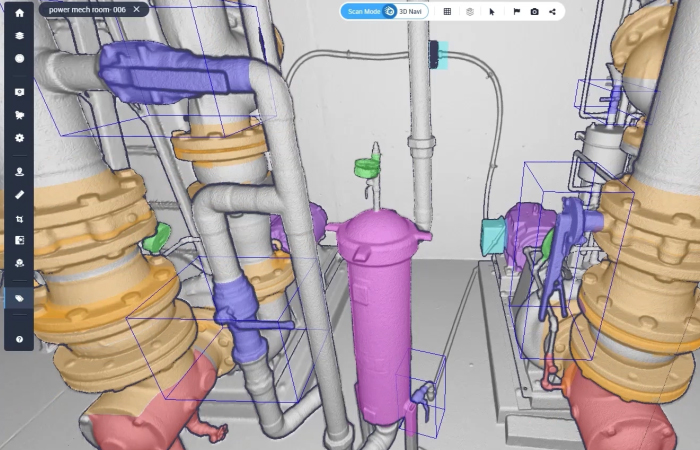
Reality capture, such as terrestrial laser scanning, mobile or drone data, gives your digital twin a millimeter-accurate record of the plant as it exists right now. For predictive maintenance, this provides:
A trusted as-built baseline: Predictive models depend on accurate context across clearances, pipe routing, equipment placement and corrosion-prone areas. As-built scan data corrects legacy drawings and gives every downstream analysis a reliable foundation.
A condition record you can compare over time: Because scans are timestamped and repeatable, teams can capture the same asset periodically and detect physical change, like deformation, displacement, corrosion, by comparing scans against each other or against the model.
Spatial context for every asset: Predictive maintenance means knowing exactly where equipment sits, what's around it, and how to plan intervention safely. Reality capture puts each asset in its physical context, allowing planning access and safety reviews can be done before anyone mobilizes.
Remote inspection that reduces exposure: Many failures hide in hazardous or hard-to-reach areas. A high-fidelity scan lets reliability and inspection teams assess conditions virtually, reducing the number of physical site visits needed and eliminating the associated risk.
From heavy point clouds to usable intelligence
Reality capture has tended to remain a survey deliverable due to its size. This is what Cintoo was built to solve.
Cintoo converts point clouds into high-resolution 3D mesh, making the data roughly 10-20 times smaller while preserving survey-grade accuracy. Instead of shipping hard drives between teams, a site can be streamed in a web browser, from anywhere, and without requiring a specialist workstation.
For a predictive maintenance program, this means:
-
Reliability engineers, planners, and contractors work from the same reality, not a patchwork of exported views
-
As-built conditions live in a single source of truth that stays accessible across the asset lifecycle
-
Scan data stops being a one-time survey cost and becomes a reusable operational layer
 Connecting the physical to the predictive
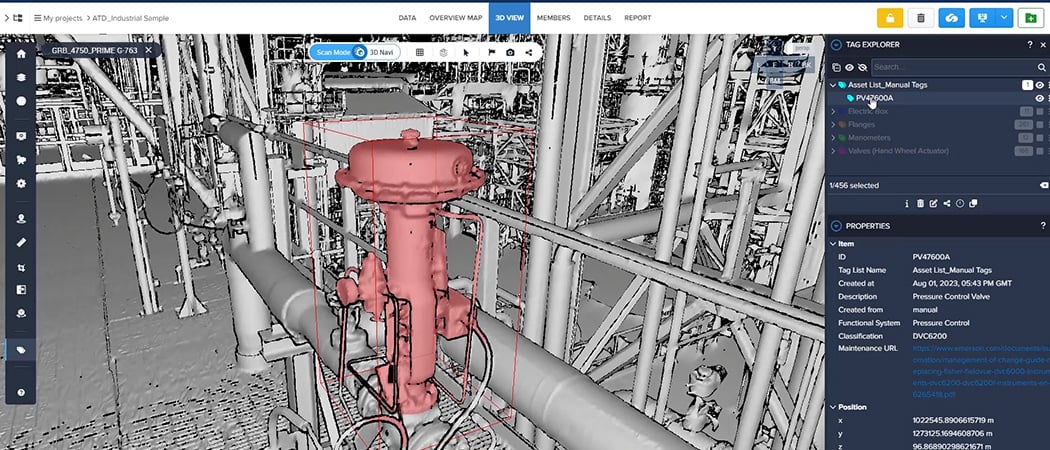
Inside a modern industrial digital twin, reality capture data then becomes the spatial foundations that other systems plug into:
- Asset tagging attaches labels, metadata, and equipment IDs directly to objects in the 3D scan so that every pump, valve, and vessel in the twin is identifiable and queryable. AI-assisted tagging can accelerate this across large facilities that would take months to tag manually.
- Connected engineering documents bring 2D P&IDs alongside the 3D environment, enabling teams to find instrumentation and validate conditions against both the documentation and what exists today in one place.
- IoT and sensor streams, like vibration, pressure, temperature and emissions, can be linked to the corresponding asset tags in the digital twin for full context.
Scan data, asset intelligence, and live performance data in one navigable environment means teams can see not only what is happening but where and how to act on it.
What it means for each team
Reliability engineers get accurate context for condition assessments, change detection between scans, and the ability to correlate sensor anomalies with the physical asset instead of chasing tags across disconnected systems.
Plant managers get fewer surprises as better as-built data and remote inspections mean fewer unplanned outages, safer and quicker turnarounds, and less time spent sending people into the field to confirm what they can glean from a scan.
Digital twin managers have an up-to-date twin that operations can confidently use, knowing it reflects reality and connects to systems they already rely on.
What usable reality capture data delivers
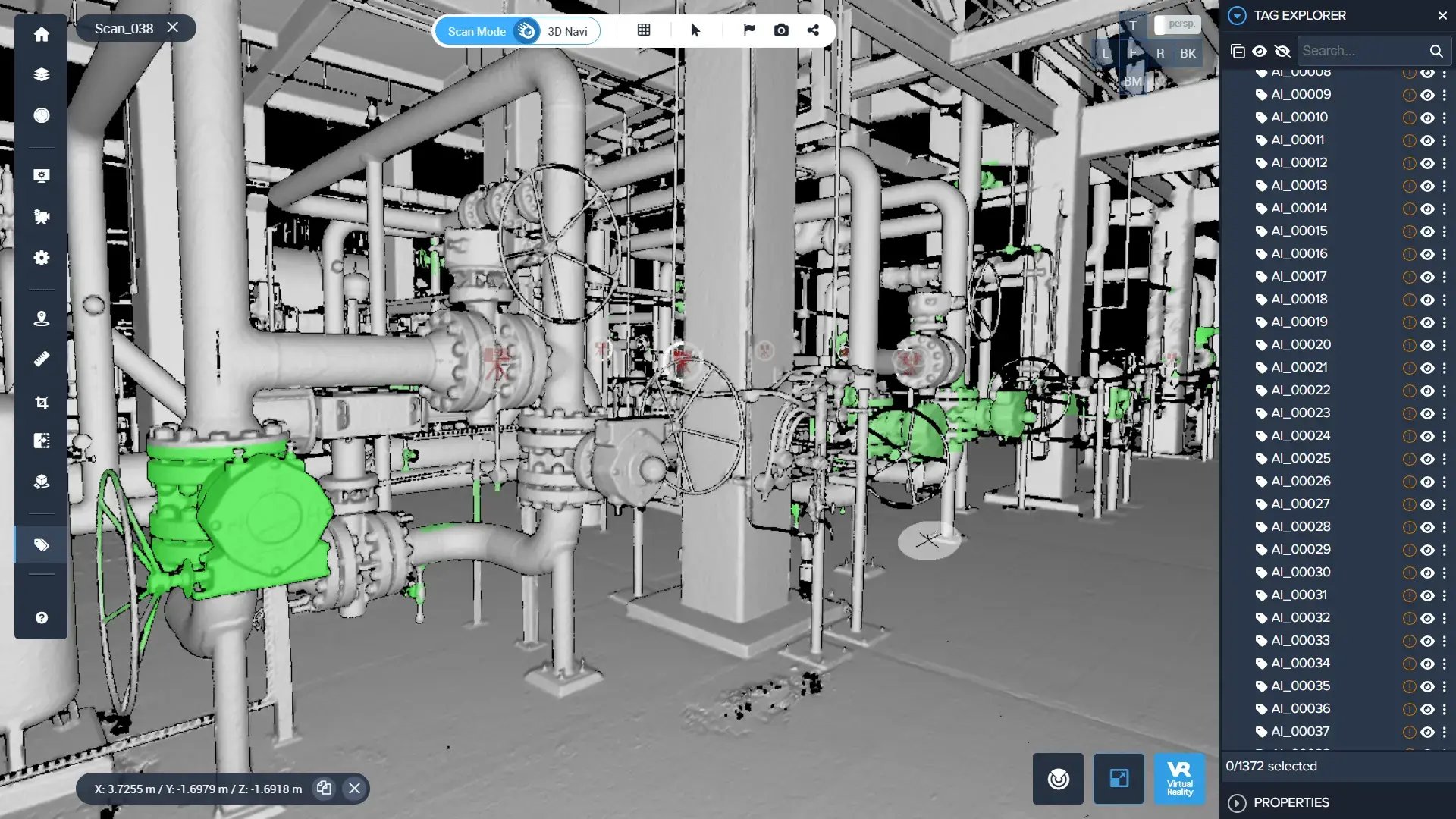
Extropic Energy, for example, used Cintoo to reduce site visits by up to 50%, cut unplanned downtime by 10-15%, and lower project rework and schedule delays by 20-30% through better coordination and clash detection.
When reality capture data is easily accessible in the cloud and connected to asset and sensor data, it becomes a valuable operational asset that supports smarter decisions across every maintenance cycle.
Start by making your scan data usable, then connect it to the engineering documents and sensor data that drive maintenance decisions.
Schedule a demo to see how your team could benefit from a single source of truth that everyone can access.



.png?width=48&height=48&name=sensors%20(1).png)
.png?width=65&height=50&name=sensors%20(2).png)


.png?width=69&height=50&name=cloud_done%20(1).png)


.png?width=42&height=49&name=Group%2015496%20(2).png)


.png?width=60&height=60&name=calendar%20(1).png)


.png?width=48&height=45&name=image%20175%20(1).png)