Industrial sites generate more data than ever, yet most teams still struggle to turn that data into decisions. Laser scans, BIM models, sensor feeds, maintenance records and engineering documents pile up in separate systems and the people who need them - operators, engineers, maintenance crews, safety leads and executives - rarely see the same picture at the same time.
AI-powered digital twins are changing this. By combining an accurate, up-to-date digital replica of a physical asset with artificial intelligence, industrial teams can search, understand, and act on their site data faster than manual workflows ever allowed. This article explains what AI-powered digital twins are, why industrial organizations are adopting them, and the concrete benefits they deliver across every stakeholder on site.
Firstly, a digital twin is a living, digital replica of a physical asset, such as a plant, factory, refinery, or piece of equipment, that mirrors its real-world condition and evolves as the asset changes. It gives distributed teams a single, navigable view of the asset without requiring anyone to travel to the site.
An AI-powered digital twin adds a layer of intelligence on top of this replica. Instead of simply viewing the models, teams can rely on AI to automatically recognize equipment, classify components, extract information from documents, detect changes, and surface insights that would otherwise take hours of manual review. The digital twin stops being a static picture and becomes an interactive source of answers.
The foundation of a trustworthy AI-powered digital twin is accurate, real-world data, which is where reality capture plays a part. Technologies, such as 3D laser scanning, capture the true as-built condition of a site down to the millimeter. When that reality capture data is streamed into the cloud and enriched with AI, teams get a digital twin that reflects what’s actually on site today, not what a drawing depicted years ago.
 Why Industrial Teams are Adopting AI-Powered Digital Twins
Several pressures are pushing industrial organisations towards aI-powered digital twins:
Aging and complex assets - brownfield facilities often have outdated or missing documentation, making it hard to plan retrofits, shutdowns, or upgrades with confidence.
Data overload - reality capture produces enormous, high-fidelity datasets. Without the right platform, that data is too large and too fragmented to be useful.
Distributed teams - engineering, operations, and contractor teams are increasingly spread across sites, regions, and time zones, and they need to collaborate on the same information.
Cost and safety pressure - every unnecessary site visit adds cost, downtime, and risk. Teams need to plan and validate work remotely.
AI-powered digital twins address all four by turning raw site data into a shared, intelligent, always accessible resource.
When accurate site data and AI-driven insights live in one place, teams stop hunting across systems and start making decisions. Questions like "what's the exact clearance around this pipe rack?" or "which valves are on this line?" can be answered in minutes from a browser, not after days of coordination.
A high-fidelity digital twin lets teams inspect, measure, and plan work remotely. Engineers can walk a facility virtually, verify conditions, and prepare interventions before anyone sets foot on site, reducing travel costs, minimizing exposure to hazardous environments, and shortening proejct timelines.
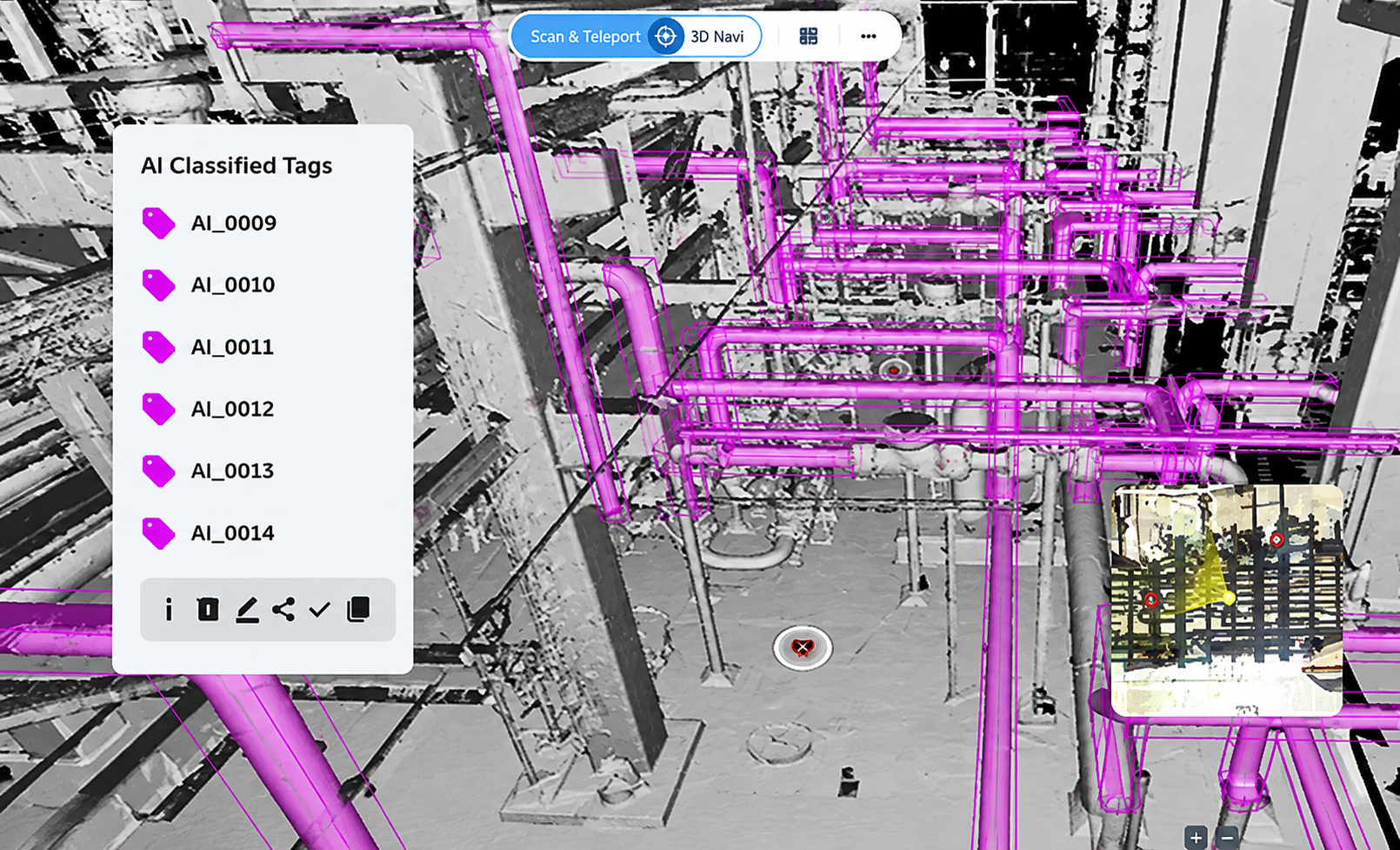
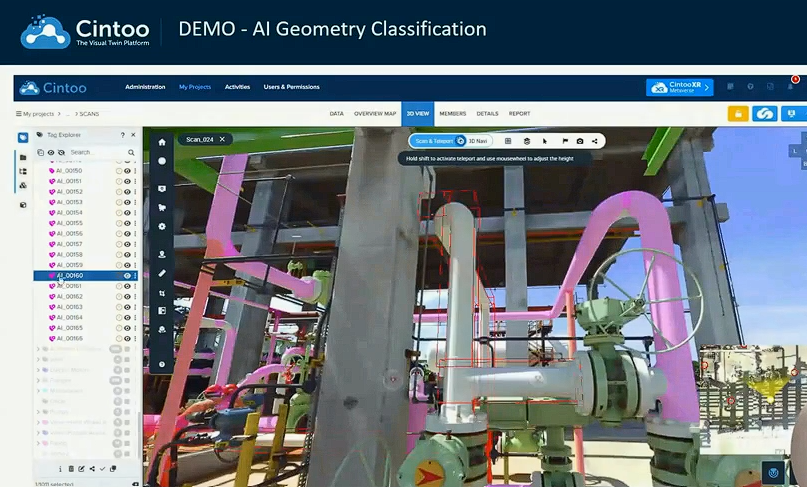
Modern platforms can automatically detect asset tags, recognize pipes and routes, and classify equipment within reality capture data. Instead of manually tagging thousands of components, teams let AI do the first pass, accelerating the creation of a structured, searchable digital twin and unlocking spatial context that would otherwise stay locked in the raw scan.
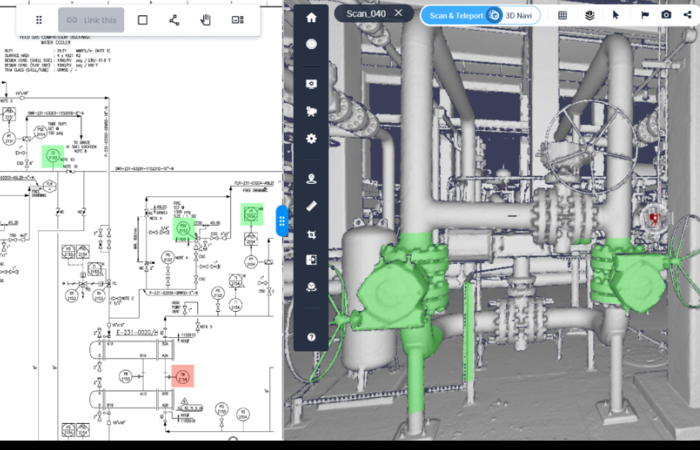
AI-powered digital twins built on reality capture give teams a verified single source of truth for as-built conditions. By comparing the captured reality against BIM or CAD models, teams can validate designs, catch discrepancies early, and keep documentation continuously up-to-date, reducing costly rework during construction, retrofit, and maintenance.
With an accurate spatial model connected to asset and operational data, maintenance teams can plan interventions with full context, reduce guesswork, and support condition-based and predictive strategies. Knowing exactly what's on site, where it is, and how it's changed over time is the starting point for smarter maintenance.
Instead of design, operations, safety and management working form different files, everyone works from the same intelligent digital twin, improving alignment and reducing miscommunication and ultimately speeding up every phase of the asset lifecycle.
 What Each Team Gains
AI-powered digital twins deliver value across the whole site and that value looks different depending on the role:
Operations and plant managers get a real-time, navigable view of the facility to support planning, coordination and day-to-day decisions
Serving all of these stakeholders from one platform is what turns a digital twin from a technical asset into an organizational one.
An AI-powered digital twin is only as good as the data underneath it. The workflow typically looks like this:
Capture the as-built condition of the site using 3D laser scanners or drones
Cintoo is built around this workflow with its patented point-cloud-to-mesh technology, which makes massive reality capture datasets accessible and easy to interpret for experts and non-experts alike. AI capabilities then layer intelligence on top, helping industrial teams move from raw point clouds to actionable insights.
Most industrial teams begin by focusing on where the value is clearest:
Choose a high-priority asset or area, often a facility facing a retrofit or shutdown
Capture its as-built condition with reality capture technology
Bring this data in a cloud platform that supports collaboration and AI-driven insight
Connect it to the BIM, GIS and other systems teams already use
Expand to additional sites as the workflow proves its value
Once this has demonstrated ROI, they can then build the case for scaling a digital twin strategy across the organization.
AI-powered digital twins give industrial teams a much-needed, single, accurate, intelligent view of their assets that every stakeholder can trust and act on. When combining reality capture with AI, organizations reduce site visits, speed up projects, improve safety, and get far more value from the data they're already collecting.
Ready to see what an AI-powered digital twin could do for your site? Request a demo to explore how Cintoo helps industrial teams turn reality capture data into actionable intelligence.