The ability to compare 3D models to as-built truth has preconditioned the digital construction industry towards enhanced precision and accuracy oveall. As projects grow in complexity, teams rely on BIM and CAD models to design, coordinate, and execute work. However, design intent alone is never enough. To truly understand what has been built, organizations must compare those models against as-built conditions captured through laser scanning.
This is where advanced comparison platforms like Cintoo play a critical role, enabling stakeholders to detect deviations, manage risk, and make informed decisions across the asset lifecycle.
BIM and CAD Models in Modern Industry
BIM (Building Information Modeling) and CAD (Computer-Aided Design) models form the backbone of modern architecture, engineering, construction, and industrial projects. These 3D models contain precise geometry and, often, rich metadata describing materials, tolerances, and system relationships.
Yet even the most detailed BIM or CAD model represents design intent, not reality. During construction, renovation, or operations, conditions inevitably change, whether due to installation constraints, fabrication tolerances, or unforeseen field conditions. This gap between design and reality makes it critical to compare 3D models against what actually exists in the field.
Why Comparing Models to As-Built Conditions Matters
As-built conditions can only be captured accurately through laser scanning, which produces dense point cloud data representing the real-world geometry of a site or facility. When teams compare 3D models to laser scan data, they gain a precise, measurable understanding of deviations.
Failing to perform these comparisons can result in:
- Costly rework
- Schedule delays
- Safety risks
- Poor fit-up during prefabrication
- Long-term operational issues
By contrast, comparing BIM or CAD models to laser scanning as-built conditions allows teams to validate construction accuracy, confirm installation tolerances, and ensure downstream design decisions are based on reality, not assumptions.
What Comparing 3D Models Reveals
When you compare 3D models against scan data, the insights go far beyond simple visual checks. Modern comparison workflows reveal:
- Geometric deviations between the model and reality
- Clashes or misalignments not detected during design
- Overbuilds and underbuilds relative to tolerances
- Installation errors early enough to correct them
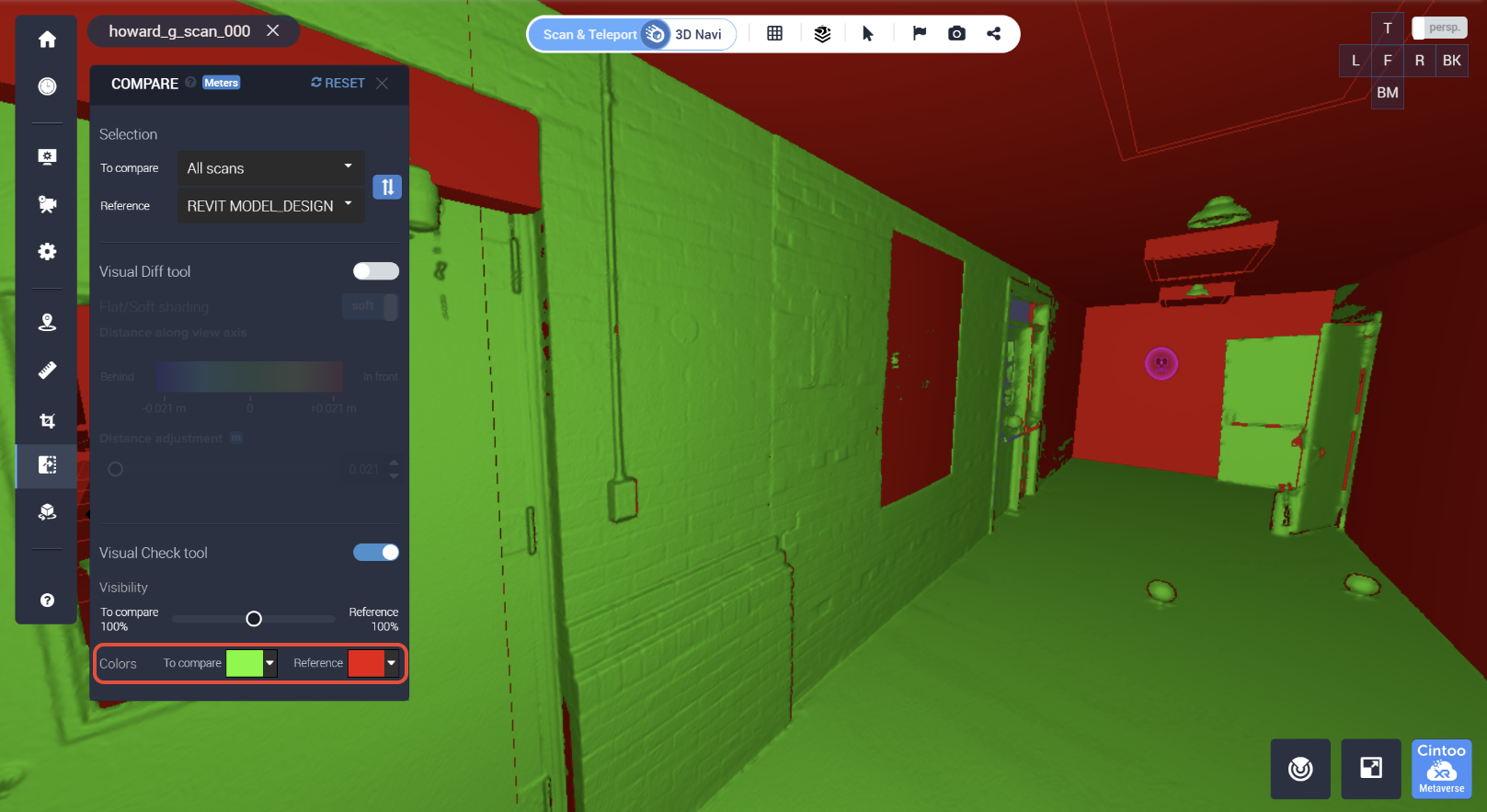
Cintoo’s comparison workflow uses visual tools that highlight these differences using color maps, making it immediately clear where scan data deviates from the model. Hot and cold colors show whether the as-built condition is in front of or behind the model surface, while green zones indicate acceptable tolerance ranges.
This level of clarity enables faster decision-making and reduces reliance on subjective interpretation.
Cintoo’s Comparison Tools for Scans and Models
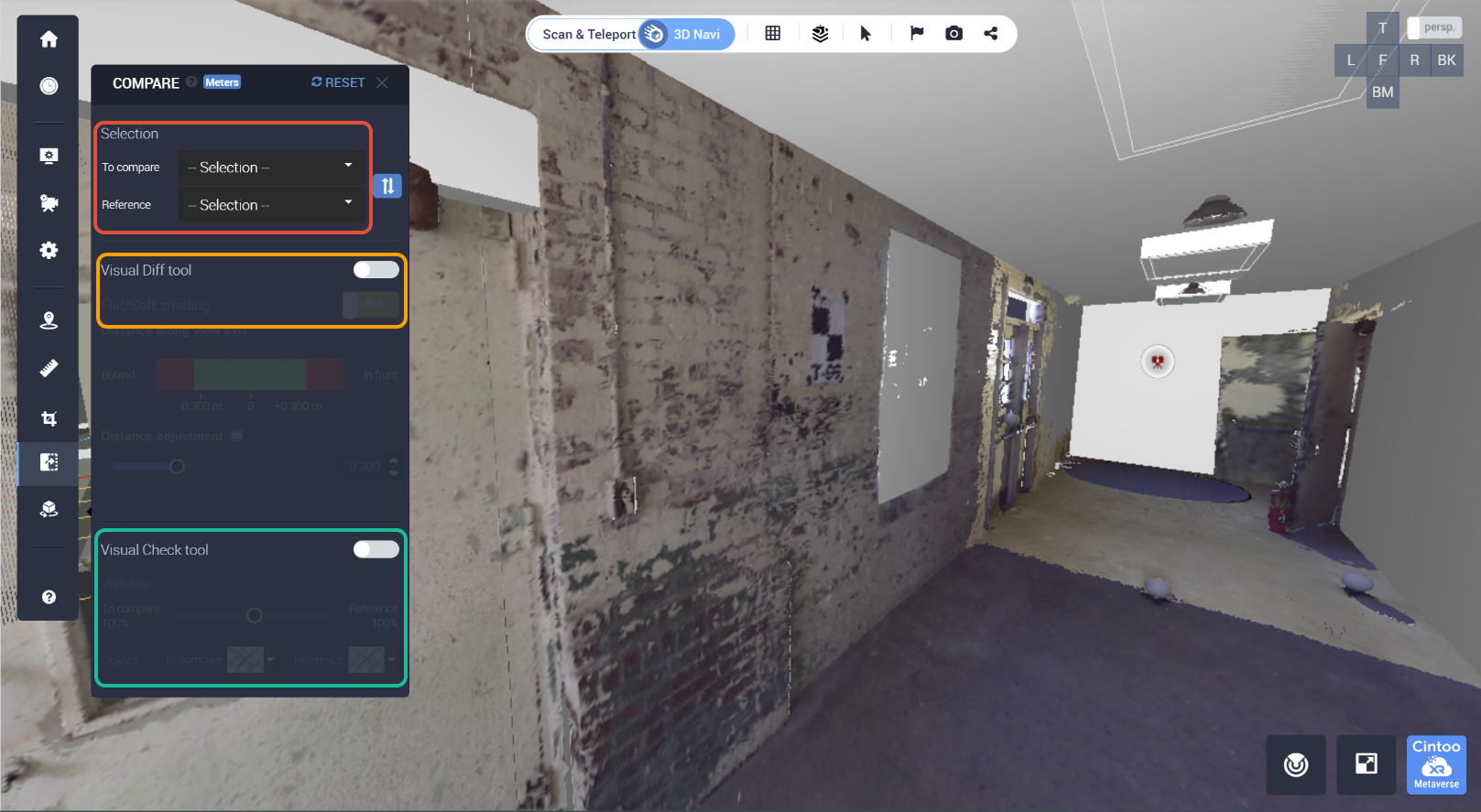
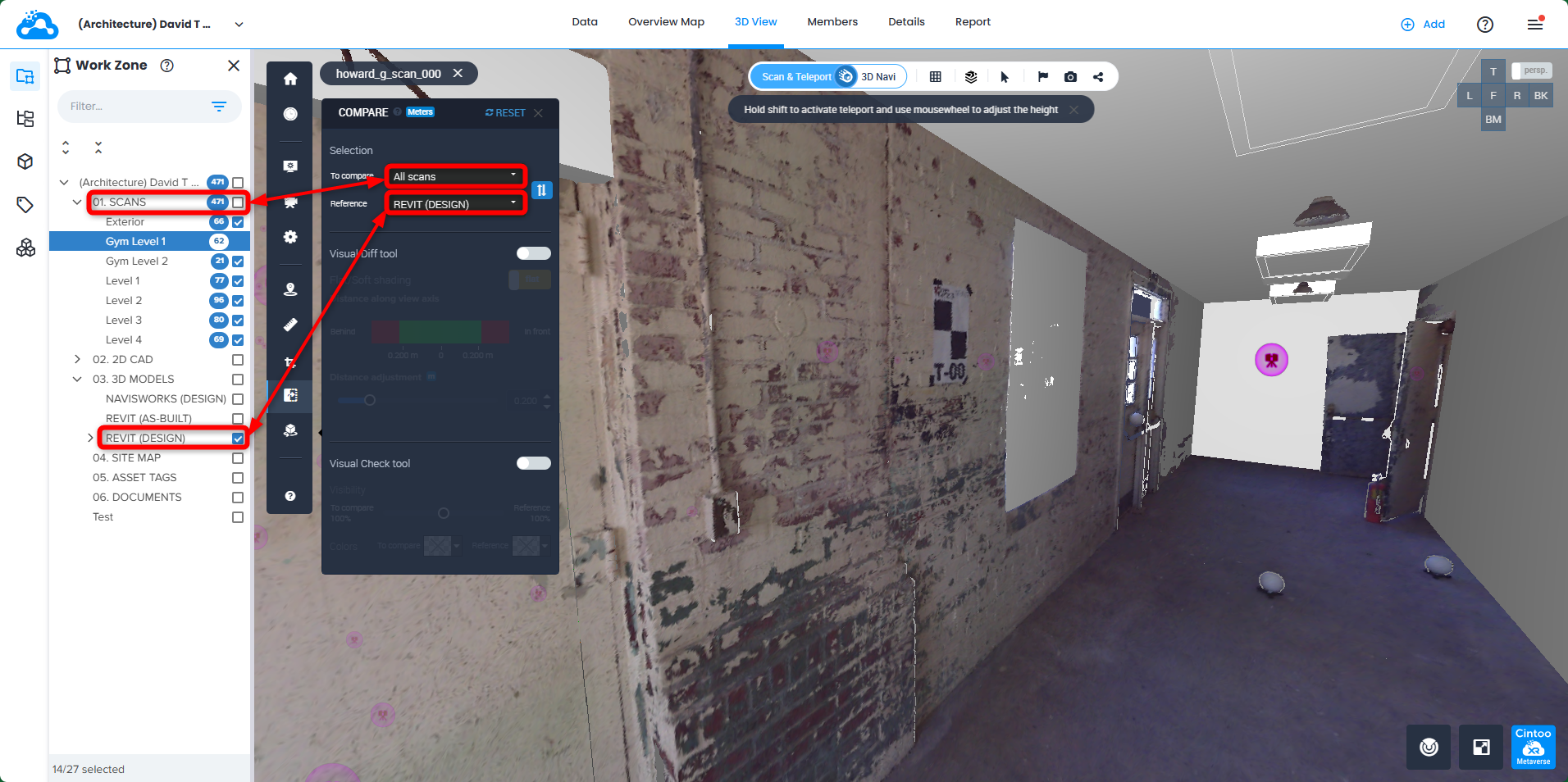
Cintoo provides dedicated Comparison Tools that make it easy to compare 3D models with reality data directly in a web-based environment. Users can select which scans to compare and which models serve as the reference, all within the same workspace.
Visual Difference Tool
The Visual Diff Tool generates a heat map that clearly displays differences between scan data and BIM or CAD models. Users can:
- Adjust tolerance ranges
- Switch between flat or gradient shading
- Instantly see where geometry falls outside acceptable limits
This tool colorizes either the scan or the model based on which element is in front or behind in the viewer’s line of sight, making complex spatial relationships easy to understand.
Visual Check Tool
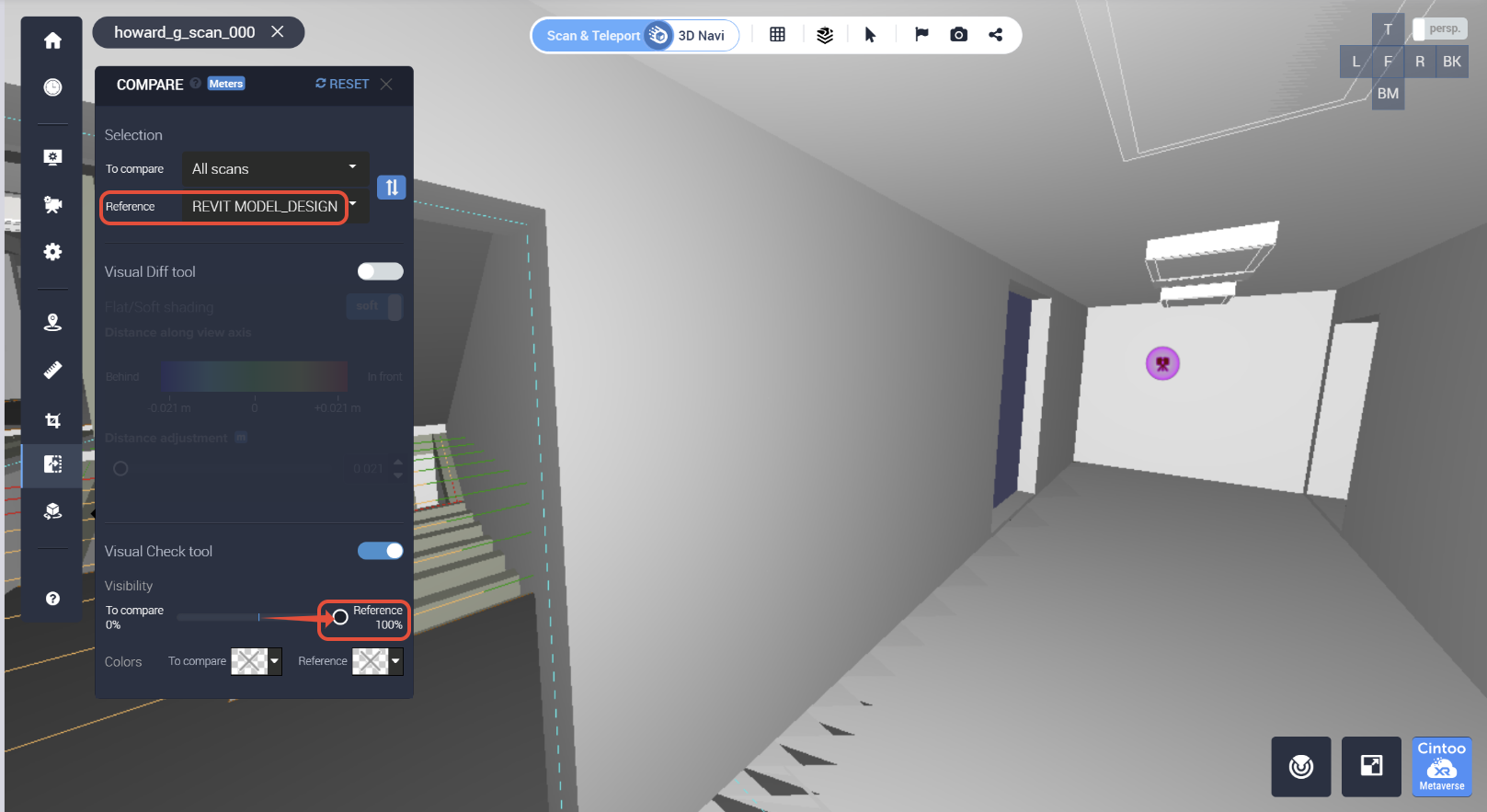
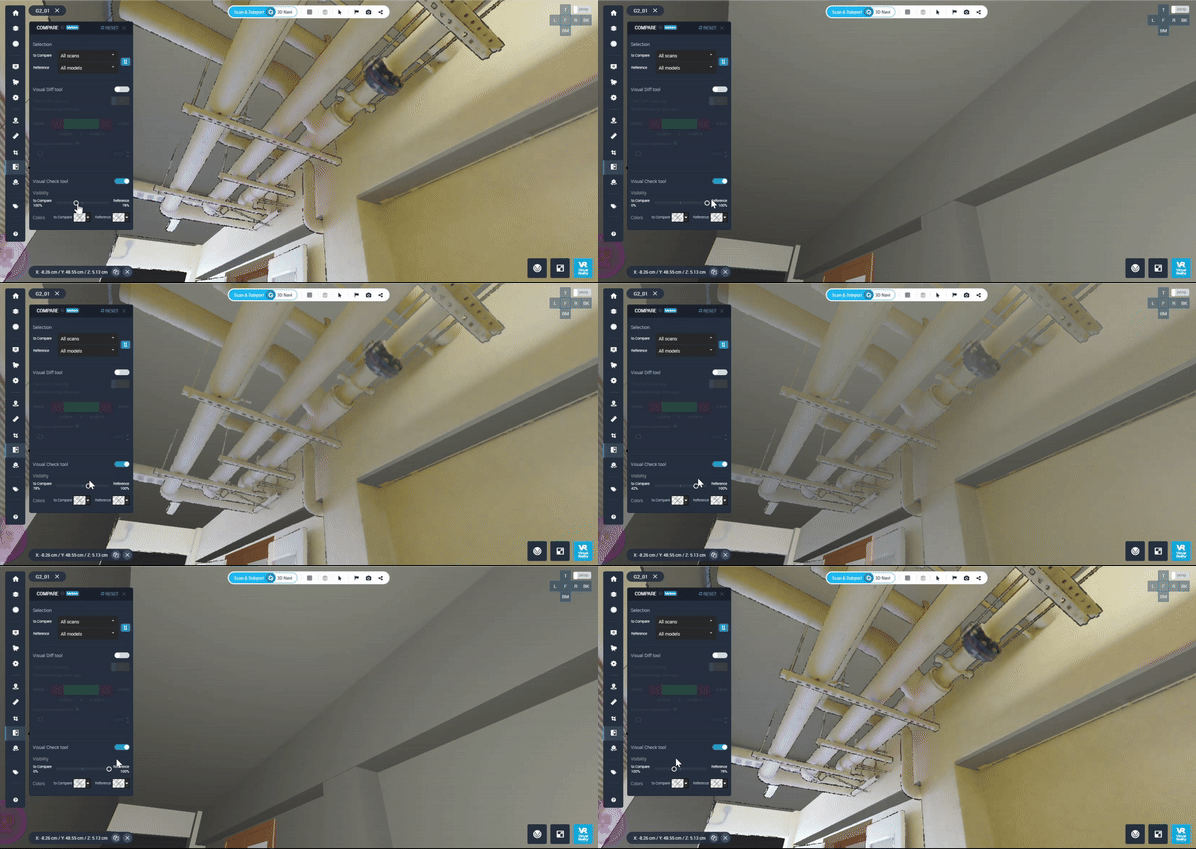
For more qualitative analysis, the Visual Check Tool allows users to control transparency between data sets. By sliding visibility controls, teams can:
- View only the scan
- View only the model
- Overlay both at full opacity
This makes it simple to visually confirm alignment, detect missing elements, or verify installation accuracy without exporting data to other platforms.
Designing in One Platform, Comparing in Another
One of the biggest challenges in digital construction is interoperability. Design teams may work in Revit, Navisworks, SolidWorks, or other modeling tools, while construction and reality capture teams rely on scan data.
Cintoo bridges this gap by allowing users to import BIM and CAD models alongside massive point cloud datasets and compare them in a single environment. This means:
- Designers can continue working in their preferred tools
- Construction teams can validate progress using scan data
- All stakeholders share a common source of truth
The ability to compare 3D models without forcing teams to abandon their existing software ecosystems is a major advantage for large, distributed projects.
Exporting and Sharing Comparison Results
Comparison doesn’t end with visualization. Once discrepancies are identified, teams often need to:
- Share findings with external stakeholders
- Update design models
- Validate digital twins against reality
Cintoo supports workflows where validated models and insights can be exported and reused across platforms, ensuring that updates reflect real-world conditions rather than outdated assumptions. This supports continuous digital twin validation throughout construction and operations.
Why Comparing 3D Models Is a Competitive Advantage
Organizations that consistently compare 3D models against laser scan data gain a measurable competitive edge. They reduce rework, improve quality, and make decisions based on accurate, up-to-date information. In one case study, Tietoa, a Cinto customer specializing in design work for major build and renovation projects in Finland, was able to more quickly deviate detections at a rate of 3-5x faster than before. Read their full story here.
By combining powerful scan-to-model comparison tools, intuitive visualization, and cross-platform interoperability, Cintoo enables teams to confidently compare 3D models at any project stage—from early construction through long-term asset management.
Explore Cintoo's BIM Edition or trial with your own data!



.png?width=48&height=48&name=sensors%20(1).png)
.png?width=65&height=50&name=sensors%20(2).png)


.png?width=69&height=50&name=cloud_done%20(1).png)


.png?width=42&height=49&name=Group%2015496%20(2).png)


.png?width=60&height=60&name=calendar%20(1).png)


.png?width=48&height=45&name=image%20175%20(1).png)