
.png?width=48&height=48&name=sensors%20(1).png)
.png?width=65&height=50&name=sensors%20(2).png)


.png?width=69&height=50&name=cloud_done%20(1).png)


.png?width=42&height=49&name=Group%2015496%20(2).png)


.png?width=60&height=60&name=calendar%20(1).png)


.png?width=48&height=45&name=image%20175%20(1).png)

“We know what engineers need, what contractors worry about, and what owners expect when downtime is measured in dollars, every minute. That’s the difference."
Angela Somerville
Founder & COO, VectorNet


Uncertainty is expensive. Heavy industrial plants, legacy facilities, and complex commercial structures share this common truth. For decades, engineers, contractors, and owners have had to make decisions based on incomplete drawings, aging documentation, and walkthroughs conducted under pressure,in tight, confined or hard to reach spaces, and often at personnel risk. In industries where downtime costs accumulate by the minute or errors can occur at the slightest incorrect fraction, a wrong assumption can multiply into a cascade of rework, safety hazards, delays, and budget issues.
To alleviate these challenges, VectorNet was created— a company built by people who have directly experienced these industry issues. The founders spent their careers in the heavy industrial sector as engineers, and process designers, constantly contending with the same core problem: the real world rarely matched the paper world. Facilities had been patched together over decades, modified during emergency shutdowns, and updated in disconnected documentation.
VectorNet was created to fix that and to replace guesswork with clarity. Ultimately, VectorNet’s work today focuses on giving industry clients something they have never truly had across the project lifecycle before: a single, accurate, accessible record of reality. “We know what engineers need, what contractors worry about, and what owners expect when downtime is measured in dollars, every minute. That’s the difference,” says Angela Somerville, Founder and COO.
Their work began with high-accuracy LiDAR capture and process engineering. But as their projects grew, so did the demands of their clients and those demands illuminated a crucial evolution in the company’s mission. Delivering accurate data was only the first part of VectorNet’s mission. They also wanted to guide clients with the second phase of delivery, helping clients use, share, manage and make the most of that data.
That realization led VectorNet to Cintoo as a strategic turning point.
This is the story of how VectorNet built a new model of clarity for industrial clients, and how Cintoo helped turn that clarity into a living digital asset. Together, the workflow has real business consequences: measurable ROI, safer operations, faster engineering cycles, and a level of confidence that changes how a facility plans and executes its work.

VectorNet’s founders realized that the gaps that engineers, contractors and maintenance teams faced day in and day out in these complex facilities led to more guesswork. And the guesswork often grew into larger problems due to a combination of factors like:
VectorNet was born to solve these problems by combining engineering judgment, advanced LiDAR scanning, and digital record-keeping into one unified solution. Instead of offering generalized scanning services, the company takes a holistic, engineering-first approach: document the real conditions of complex facilities with the accuracy required for design, safety, and construction and present that information in a way that reduces risk at every step.
From the beginning, VectorNet distinguished itself by being able to move between both modes. They understand the technical needs of engineering and design, but they also, at the core, understand the big challenges that contractors and owners are often up against.
Their hybrid perspective becomes a powerful differentiator.
VectorNet’s mission became simple: provide clarity where clarity is scarce or unprioritized and do it in a way that supports decision-making from design through long-term asset management.
The question is: how does this look in actuality?
The company’s client base reflects exactly the environments where clarity is mission-critical:
These are organizations where a single undocumented change can derail a shutdown, a mismeasured tie-in can delay a multimillion-dollar installation, and a construction verification error can cascade into rework and schedule overruns.
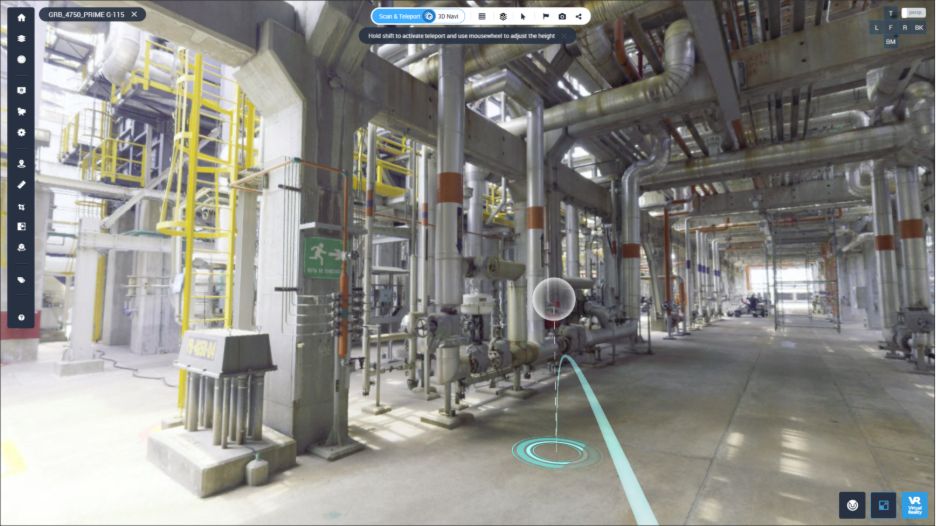
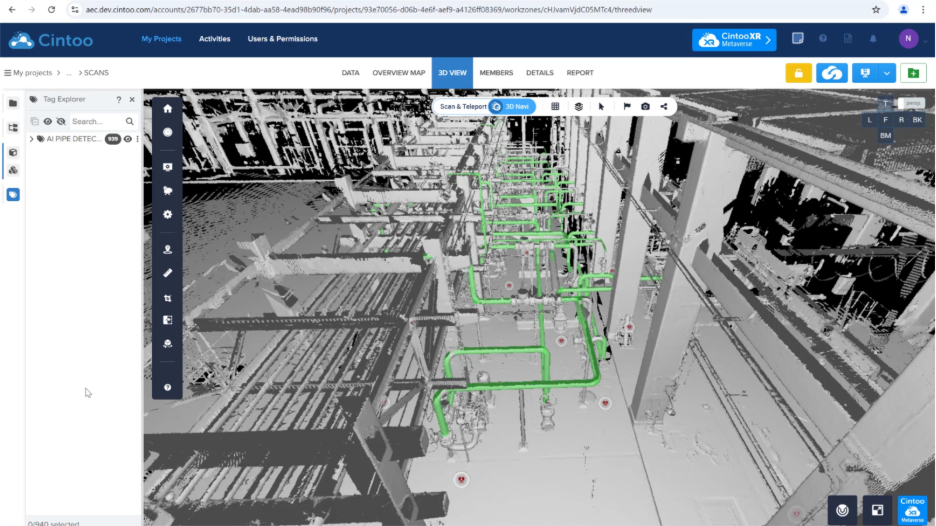 Industrial facilities visualized in Cintoo – converted laser scan to 3D mesh.
VectorNet built its services around the idea that deliverables must match the phase of the project and the risk involved. As Somerville puts it, “There is no single scanning method that works for everything. The value VectorNet brings is knowing which methodology fits the risk, accuracy demands, and schedule.” Their LiDAR strategy is not a one-size-fits-all; it adapts to the client’s needs across the entire lifecycle:
At project start:
During data handover/design/construction and shutdowns or long-term facility management:
Once the scan is delivered, the value does not stop. The data that VectorNet provides establishes the baseline for a living record of the facility and clients can use that data seamlessly for all sorts of different use cases, without having to step foot on site.
This tailored approach keeps projects efficient, accurate, and rooted in the realities of engineering and construction.
Using data beyond the capture is a hallmark of both VectorNet and Cintoo’s approach to delivering on project outcomes.
Data can be translated into decisions through a number of different use cases, such as:
Plan work orders
For VectorNet’s clients, LiDAR is no longer just a single snapshot in time. It is a living reference that informs every stage of the project lifecycle.
As VectorNet’s client base grew, so did the need for a platform that could support the long-term value of their data. Their clients needed a way to store, manage, analyze, and share point clouds without technical barriers or specialized software.
This need emerged from several real industry problems:
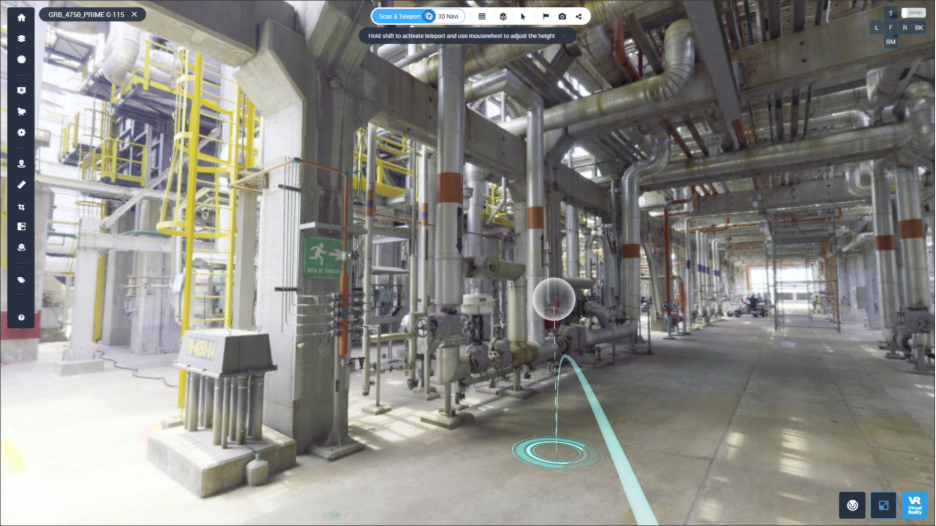 Point clouds are ingested and streamed as high-fidelity meshes, easy to navigate from anywhere within the project.
VectorNet turned to Cintoo as a solutions leader for their clients. Cintoo allows their clients to make long term use of the reality capture data, ideal because the solution provides:
For VectorNet, Cintoo transformed their data from a deliverable into a working asset and their clients then could create a full end-to-end loop of data acquisition and usability.
When VectorNet adopted Cintoo, their clients immediately gained new capabilities that changed how they approached planning, engineering, construction, and maintenance. The high precision data captured by VectorNet could be used for further workflows that extended the life of the data and the usability of it beyond pure visualization.
Cloud-based access to high accuracy scans meant clients didn’t need specialized software to download and interpret that data. All of it was streamed in a web-based browser with no compromise to accuracy. Cintoo’s mesh streaming maintains the accuracy of the source scanner.
Precise measurement, annotation and comparison tools also represent a few ways that clients can use their facility digital twin to get more from the data.
For instance, clients can perform measurements in the platform of:
Annotations, on the web-based browser, allow teams to communicate issues across stakeholder by tracking changes and alerting their colleagues. Reports can be downloaded and distributed.
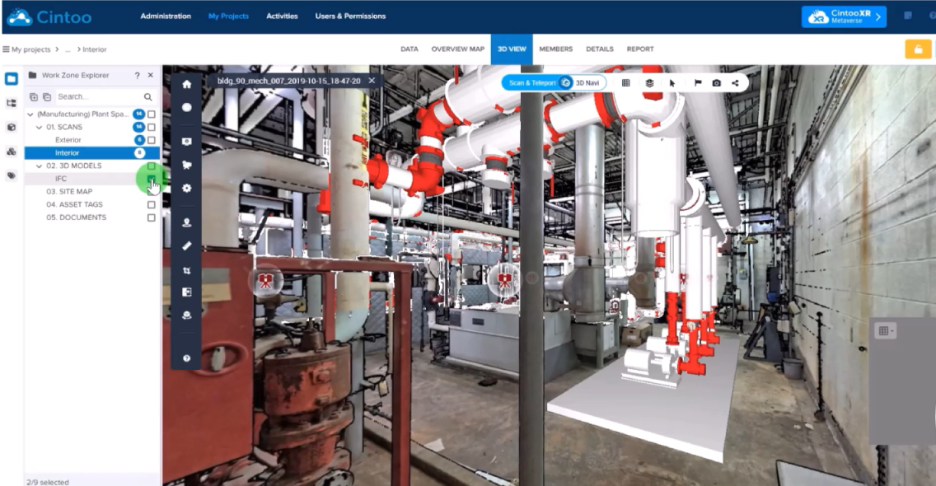 BIM models can be overlayed against the scan data for precision-based insights.
Variance and deviation analysis also become easier to facilitate in Cintoo. Clients can compare designs and models to the as-built conditions, confirm installations, and detect deviations early. This supports QA/QC during shutdowns or ongoing construction.
Many of VectorNet’s clients in heavy industry facilities require frequent walkthroughs for safety and planning. These types of actions can be facilitated in the platform, providing clarity while reducing onsite visits.
Side-by-Side comparisons of multi-phase scans also becomes an important part of the process, allowing users to track modifications, identify undocumented changes, evaluate progress and maintain long-term asset management.
By building off the accurate scan data provided by VectorNet across a variety of scanners, the as-built conditions in the platform reflect reality and create a space where collaboration and actionable data are easy to facilitate. This makes it intuitive for engineers, contractors and vendors to work together over the same reference source of truth.
It starts with a challenge- VectorNet is required to deliver the survey of a client’s facilities and assets. VectorNet’s team establishes project goals, data deliverables, and the best method, using a mix of scanners dependent on the job site.
VectorNet performs reality capture using high-accuracy scanners to capture all the conditions. The data is delivered to the client and further guidance is offered in streaming that data in Cintoo where it can be visualized, managed, shared and stored.
Impact for Engineers, Contractors, Owners and Maintenance and Operations teams:
And because the data can be integrated with BIM, GIS and IoT platforms, teams can combine data points, creating a bidirectional flow based on the reference source of truth.
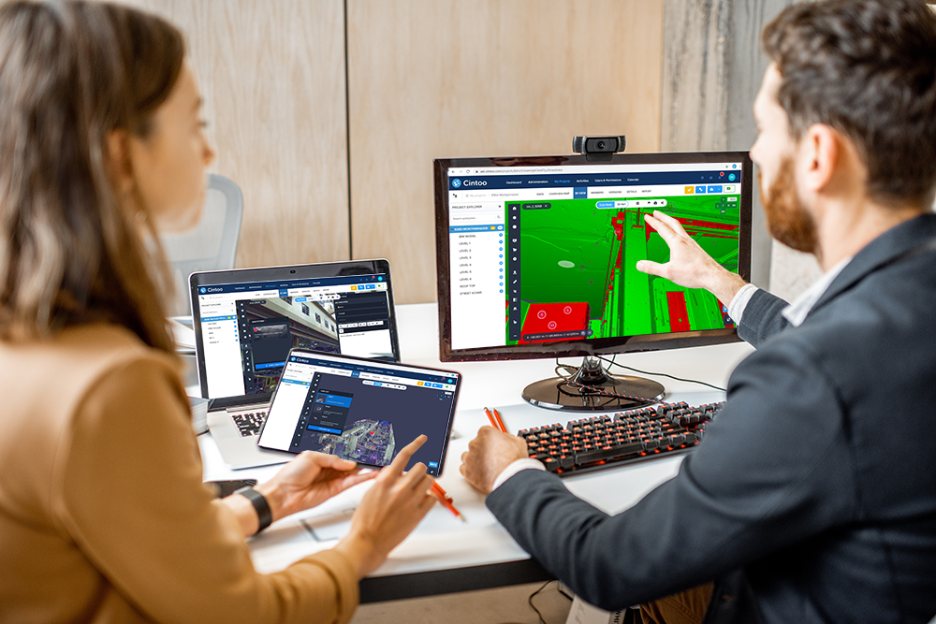
The combination of VectorNet’s scanning and Cintoo’s analysis tools provides the clarity clients need. It helps prevent potential failure, reduce risk to personnel, and plan interventions with clarity.
Clients experience measurable returns across the project lifecycle.
Fewer shutdown surprises and less overtime: When you know exactly what you’re walking into, you avoid the classic shutdown killers like hidden interferences, missing information and last-minute rework.
Reduced fabrication errors: With accurate LiDAR data and variance checks, VectorNet can support fabrications with confidence.
Lower field labor costs: Teams don’t need to perform as many onsite visits or plan access. The data is already there.
Faster and more accurate engineering decisions: Engineers can review the plant virtually, measure within Cintoo, and coordinate designs.
Less construction rework and tie-ins: Accurate as-built means less guesswork.
Long-term asset clarity: Owners obtain a permanent digital record that does not disappear with changes.
Improved safety outcomes: Planning with accurate data means fewer blind spots.
Higher productivity throughout the entire lifecycle: From early design through construction and maintenance, the combination of VectorNet’s accuracy and Cintoo’s accessibility reduces friction at every step.
VectorNet is continuing to expand their work in the heavy industrial market by building deeper partnerships with owners, engineers, maintenance teams, and partners who depend on accurate information to keep facilities running safely and efficiently. Their next steps focus on strengthening that support.
In addition, VectorNet is scaling their reality capture capabilities, adding more process engineering depth, and integrating tools like Cintoo, with P&IDs, even further into client workflows so teams can plan, design, and maintain with complete clarity. The investments in more field technology, more training, and additional staff to keep pace with the growing demand for high accuracy data also continues.
Movin forward, VectorNet’s goal is simple: give clients a reliable partner they can count on every time they need the truth about their facility. VectorNet is committed to providing the accuracy, insight, and experience that heavy industrial clients need to work with confidence.
Together, VectorNet and Cintoo are redefining what clients can expect from reality capture:
This is reality redefined and facilities that embrace it gain a competitive, operational, and strategic advantage beyond single-use data. Explore VectorNet in more detail and extend the value of your reality capture investment.
VectorNet is more than just a reality capture and laser scanning service provider. VectorNet provides customized, innovative technology solutions to their customers while extending the value of reality capture, all throughout the project lifecycle.